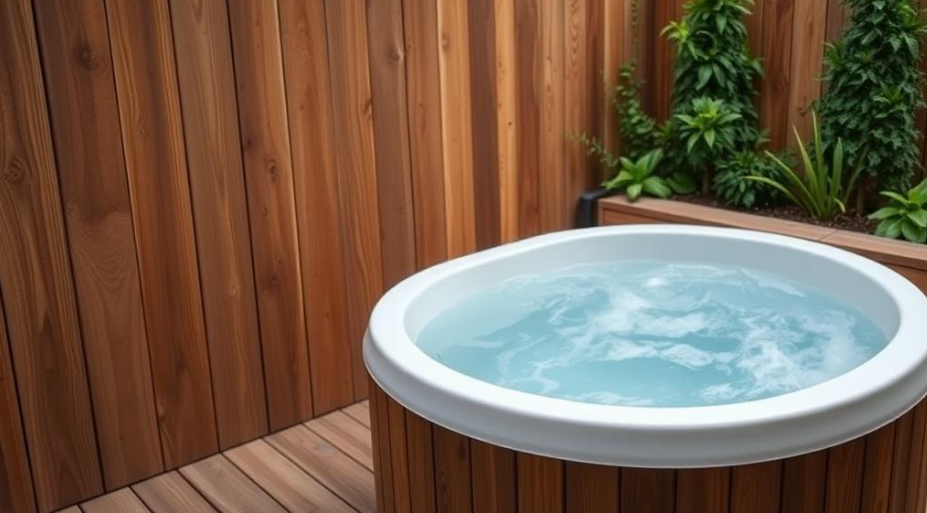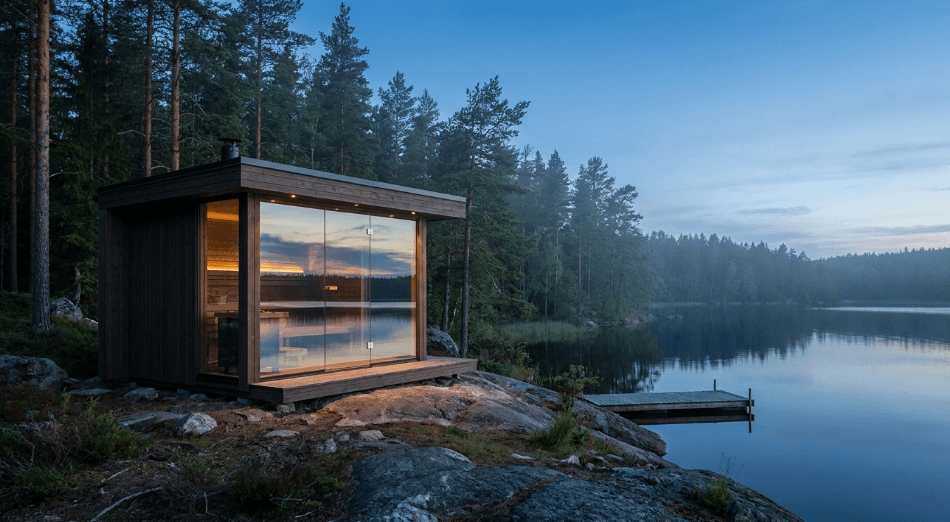
When a yard cannot accommodate a full 6×8 cabin, a barrel sauna is the most space-efficient alternative, fitting two to three people into roughly a third of the footprint by using a curved shell instead of four flat walls. The tradeoff is less headroom at the edges and a build that depends heavily on stave quality and a proper cradle base, so getting those details right matters more on a compact unit than it does on a full cabin.
Why does a barrel shape use less space than a cabin?
A cabin needs four vertical walls and a flat roof, all of which take up ground area even in the corners where nobody sits. A barrel sauna’s curved staves, the individual tongue-and-groove wood boards that form the round shell, taper the usable space toward the top, but the footprint at ground level is dramatically smaller for the same two-person seating capacity. A typical 6 to 7 foot diameter barrel needs only 25 to 30 square feet of pad, compared to 48 square feet or more for a small rectangular cabin, which makes it the practical choice for a narrow side yard, a small deck corner, or a lot with a tight setback requirement from the property line.
What holds a barrel sauna off the ground?
Every barrel needs a cradle, a pair of curved wood or steel rails that the round shell rests in in place of a flat foundation. The cradle keeps the barrel from rolling, lifts the staves off standing water, and lets air circulate underneath to reduce rot risk. Skipping a proper cradle in favor of just setting the barrel on blocks is the single most common installation mistake, since uneven support stresses the staves and can throw the door out of square within a season. A cradle typically raises the floor 8 to 12 inches off grade, which also helps with rain runoff, since water sheds straight off the curved roof rather than pooling against a flat one.
How do you pick a barrel diameter that still feels roomy?
Diameter drives both capacity and comfort. A 6 foot diameter barrel fits two people on facing benches but leaves limited headroom near the curved walls, which taller users notice quickly. Moving up to 7 or 7.5 feet in diameter adds real elbow and shoulder room without a large jump in footprint, since the added square footage grows with the radius rather than doubling the overall space needed. For a household of three who will realistically use it together sometimes, a 7.5 to 8 foot diameter barrel with a bench configuration for three is usually the better buy than a tight 6 foot two-person model, even though the price difference is modest.
What other compact formats exist besides a barrel?
Pod-style and vertical cabin saunas are the other common option for tight spaces, using a smaller square or hexagonal footprint with a taller ceiling instead of a wide curved shell. These fit well against a fence line or under a covered patio where a barrel’s round shape would waste corner space, though they generally cost 10 to 20 percent more than a comparably sized barrel because the flat-panel construction uses more material per cubic foot of interior volume. Buyers narrowing down a compact footprint against their available yard space can review current barrel and small-cabin options through the SweatDecks outdoor saunas collection to compare diameters, bench layouts, and heater pairings side by side before settling on a specific model.
What should a first-time barrel buyer check before ordering?
Stave thickness and wood grade matter more on a barrel than most buyers realize, since the curved shell is doing structural work that a flat cabin wall does not. Look for staves at least 1.6 to 2 inches thick in kiln-dried Nordic spruce, Canadian red cedar, or thermally modified wood, joined with a tight tongue-and-groove fit and stainless steel hoops rather than painted steel, which rusts faster in a wet outdoor environment. Ask specifically about the cradle, whether it ships included or is a separate purchase, since a barrel without a proper cradle is not really usable until one is sourced or built.
How does rain runoff affect a barrel differently than a cabin?
A flat cabin roof needs its own pitch and drip edge engineered in to shed water away from the walls, and a poorly built one can pool water at the seams over time. A barrel’s curved top is naturally self-shedding, since rain and melting snow run straight off the round profile with nowhere to collect, which is one of the underrated practical advantages of the shape beyond the smaller footprint. That said, the door and window frame are still flat cutouts in the curve, so those seals need the same attention to caulking and weatherstripping as any cabin door, and a small overhang above the door keeps direct rain off the hinges and handle.
Ground contact is the other side of the water equation. Because a barrel sits raised in its cradle rather than on a full foundation, airflow underneath dries out any dampness quickly after a storm, which is part of why properly cradled barrels tend to hold up well even in wetter climates, provided the staves themselves are a rot-resistant species to begin with.
What does a compact barrel setup cost start to finish?
A 2 to 3 person barrel sauna with an electric heater typically runs $3,200 to $5,500 for the unit itself, depending on wood species and stave thickness, with the cradle either included or adding $150 to $400 separately. Add a concrete paver pad, which most homeowners can lay themselves for under $200 in materials, and a dedicated electrical circuit run by a licensed electrician, commonly $300 to $700 depending on distance from the panel. All in, a complete small-footprint barrel setup lands meaningfully below a full-size cabin project once electrical and site work are included on both, which is part of why barrels are the common recommendation for a first sauna in a space-constrained yard.
Frequently Asked Questions
What is the smallest outdoor sauna that still fits two people?
A barrel sauna with a 6 to 7 foot diameter fits two adults on facing benches in about 25 to 30 square feet of footprint, roughly a third the ground area of a rectangular 6×8 cabin.
How much clearance does a barrel sauna need around it?
Plan for at least 12 to 18 inches of clearance on the sides for the curved shell and roughly 3 feet in front of the door for entry and exit. Heater venting on wood-burning models needs additional rear clearance per the manufacturer’s spec.
Can a barrel sauna sit directly on grass or dirt?
No. It needs a level, stable base such as a cradle frame, pressure-treated skids, or a paver pad, both to keep the curved shell from rocking and to keep ground moisture away from the staves.
Do small outdoor saunas need less electrical capacity?
Yes, generally. A 2-person barrel typically pairs with a 4.5 to 6kW heater rather than the 7 to 9kW units used in larger cabins, which can sometimes run on a smaller dedicated circuit depending on local code and the specific heater’s amperage draw.
References
- Hussain, J. et al. “Cardiovascular and Other Health Benefits of Sauna Bathing: A Review of the Evidence.” Mayo Clinic Proceedings, 2018. https://pubmed.ncbi.nlm.nih.gov/30077204/
- “Clinical Effects of Regular Dry Sauna Bathing: A Systematic Review.” Evidence-Based Complementary and Alternative Medicine, 2018. https://pubmed.ncbi.nlm.nih.gov/29849692/
- “Benefits and risks of sauna bathing.” The American Journal of Medicine, 2001. https://pubmed.ncbi.nlm.nih.gov/11165553/