Renu Therapy Cold Plunge Guide and Specs is worth evaluating through the homeowner’s real week, not a perfect catalog photo. The best setup is the one that gets used, stays safe, and does not become a maintenance headache.
My neighbor Dave, a physical therapist who works with triathletes in the Twin Cities, bought a cold plunge last October. He spent three weeks researching chiller specs, tub materials, and water chemistry. Then he set the unit on a patch of bare dirt next to his garage, plugged it into a shared outlet that also powered his chest freezer, and wondered why the GFCI kept tripping every time the chiller kicked on. The plunge itself was great. Everything around it was a mess.
That story captures the core problem with how most people approach a cold plunge purchase: they obsess over the unit and underweight everything else. The pad, the electrical, the climate math, the maintenance cycle. Those boring logistics determine whether you’re still using the thing in February or whether it’s sitting under a tarp collecting leaves.
This guide covers the full picture for Renu Therapy and similar residential cold plunges: real specs, real costs, the research worth knowing, and the install details that separate a good buy from an expensive headache.
What Actually Matters on a Spec Sheet
Most cold plunge spec sheets are designed to impress, not inform. Here’s what to actually look for before committing money.
Chiller sizing. This is the single biggest functional decision. A 1/3 HP chiller can hold 50°F in a small insulated tub in Portland. It will struggle badly in a Phoenix garage in August. A 1 HP commercial-grade chiller is overkill for a 75-gallon tub in Minnesota but appropriate for a larger stainless unit in a warm climate. Match chiller HP to tub volume and your local ambient temperature range. Read the manufacturer’s published sizing chart instead of trusting a Reddit thread from someone in a completely different climate zone.
Filtration and sanitation. Purpose-built residential plunges typically combine ozone, UV, and a 5-micron filter cartridge. This combo keeps water clear for 6 to 12 weeks between full drains. Units that skip ozone or UV will need more frequent water changes and manual chemical management.
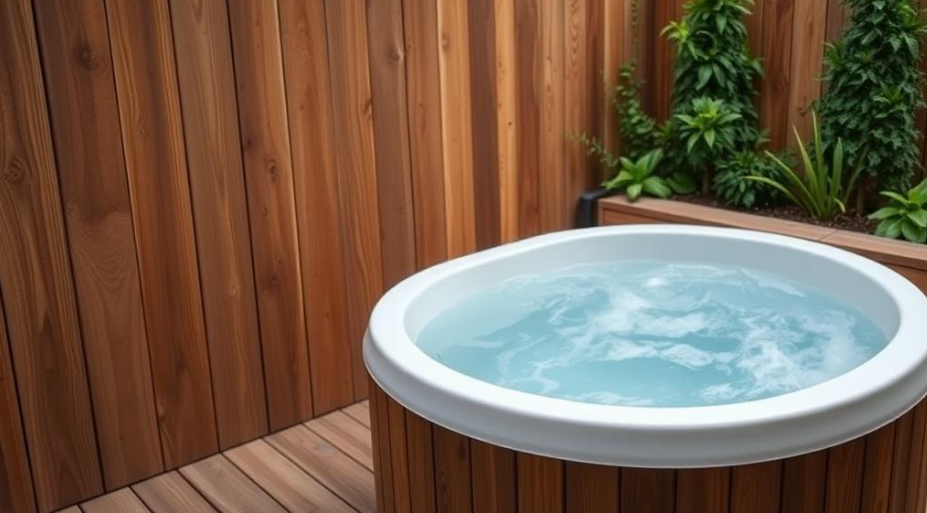
Tub material. Stainless steel is the gold standard for durability and sanitation. Some units use high-density polyethylene or acrylic. Stainless costs more but cleans easier and resists biofilm better over years of use.
Electrical draw. Plug-and-play 110V models exist and work fine for many residential setups. Commercial-grade chillers often require 240V hardwire, which always means a licensed electrician. Know which category your unit falls into before it arrives on a pallet.
The catch is that none of these specs matter in isolation. A beautiful stainless tub with a great chiller, sitting on a settling gravel pad with an undersized circuit, is still a bad install.
The Health Research (Honest Version)
Cold-water immersion research has come a long way from “tough guys sitting in ice baths.” The data is real, but it comes with important caveats.
Heinonen and Laukkanen reviewed cold-water immersion outcomes in 2018 (Frontiers in Physiology) and reported reductions in self-reported muscle soreness, modest improvements in mood, and changes in catecholamine signaling after 2 to 5 minute immersions at 50°F to 59°F. The mood piece is the one most home users actually notice first. That post-plunge alertness isn’t placebo. It’s a norepinephrine spike, and it’s well-documented.
A 2022 systematic review by Allan and colleagues (European Journal of Applied Physiology) examined cold-water immersion after resistance training and found recovery benefits, but flagged that very frequent immersions immediately after lifting may blunt some hypertrophy signaling. The practical takeaway for home users: keep cold sessions to 2 to 5 minutes and separate them from heavy resistance training by at least 4 hours when muscle growth is the goal. If you’re training for general fitness and recovery, the timing matters less.
Here’s the part people don’t want to hear: cardiovascular response to cold immersion is real and worth respecting. Heart rate and blood pressure spike within seconds of submersion. Adults with arrhythmias, uncontrolled hypertension, Raynaud’s phenomenon, or who are pregnant need to get explicit clearance from a physician before any home use. This isn’t a liability disclaimer I’m including because I have to. I genuinely think a 10-minute conversation with your doctor is the cheapest, smartest investment in this entire project.
Pad, Electrical, and the Boring Stuff That Actually Matters
A cold plunge install is simpler than a sauna build. Most modern residential units are factory-wired with integrated chiller, ozone, and filtration. Your job is the pad, the water fill, the GFCI outlet, and the maintenance routine.
The pad. A full tub of water plus a steel chassis puts 800 to 1,200 lb on a small footprint. People underestimate this constantly. A 4-inch compacted gravel pad with proper drainage works for many backyard installs. A 4-inch reinforced concrete pad is the right call on soft soil or anywhere with freeze-thaw cycles. Fixing a pad after the unit is on top of it costs three times what doing it right the first time costs. (Dave learned this the hard way. His tub tilted two inches toward the garage wall by December.)
Electrical. Plug into a properly grounded GFCI outlet on its own dedicated circuit. If your nearest outlet is more than 25 feet away or shares a circuit with other high-draw appliances, have a licensed electrician run a dedicated 20A 110V circuit. For 240V commercial chillers, an electrician is non-negotiable. Budget $600 to $1,800 for a new 240V run depending on distance and local labor rates.
Water care. Test pH and sanitizer levels weekly. Replace filter cartridges every 6 to 12 weeks. Drain and refill on the manufacturer’s schedule. This takes maybe 15 minutes a week once you have a routine. It’s the cold plunge equivalent of skimming a pool. Boring, necessary, and the reason your water stays clear instead of turning into a science experiment.
What This Actually Costs (All-In)
The sticker price on a cold plunge is not the all-in number, and the all-in number is the only one that matters.
Residential insulated tub with integrated chiller: $4,500 to $7,500. This covers most of the purpose-built home market, including units from Renu Therapy and comparable brands.
Commercial-grade stainless build with full filtration: $9,000 to $14,000. Overkill for most home users, appropriate for someone who wants gym-level equipment in their backyard.
Stock-tank DIY setup: $400 to $900, but you’re hauling ice manually. Every session. Forever. I know people who love this approach. I also know people who did it for six weeks and then bought a chiller.
Add-on costs people forget:
- Gravel pad: $400 to $900
- Concrete pad: $1,200 to $2,400
- Dedicated electrical run: $600 to $1,800
- First year of filters, test strips, and water care supplies: $100 to $200
So a realistic all-in for a mid-tier residential cold plunge, properly installed, lands somewhere between $5,500 and $10,000. That’s the honest number.
On the tax side, some home wellness equipment can be reimbursed through HSA or FSA accounts when a Letter of Medical Necessity (LMN) is on file. Services like TrueMed issue LMNs after a short clinician review for conditions where cold therapy is a recognized treatment input. Eligibility is patient-specific and IRS rules are strict. Talk to your tax advisor before assuming a purchase qualifies.
How It Stacks Against Alternatives
A purpose-built insulated tub with a 1 HP chiller holds 39°F to 45°F all day with zero manual intervention. That’s the baseline.
A stock-tank conversion with bags of ice can hit the same temperatures, but you’re buying ice, hauling ice, and watching the water warm up within 20 minutes of adding it. For occasional use, this is fine. For daily use, it’s a part-time job.
A chest-freezer conversion is cheap (often under $500 total) but lacks filtration, has no sanitation system, and is mechanically marginal. The compressor wasn’t designed for this duty cycle. Some people run these for years. Some burn out the compressor in four months. It’s a gamble.
My honest take: the right answer is almost never the cheapest option or the most expensive one. It’s the build that matches your climate, your available space, your electrical situation, and (most importantly) the routine you’ll actually maintain. A $5,000 plunge you use five mornings a week is a better investment than a $12,000 plunge you use twice in January and then ignore.
For a longer reference comparing specific model lineups, sizing, and install considerations in detail, see this sauna health benefits & therapy guide. It’s the kind of page worth bookmarking before you start a build.
Three Moments to Call a Professional
The pad. Especially in freeze-thaw climates or on soft soil. A contractor or experienced handyman here costs a few hundred dollars and saves thousands in fixes later.
The electrical. Any 240V work requires a licensed electrician, full stop. Even 110V work beyond plugging into an existing outlet should involve someone who knows local code.
The health conversation. If you have any cardiac history, blood pressure issues, Raynaud’s, are pregnant, or manage a chronic condition, talk to your physician before you start. The research on cold immersion for healthy adults is encouraging. “Encouraging for healthy adults” is not the same as “safe for everyone.”
FAQs
How long should a typical cold plunge session last?
Most adults benefit from 2 to 5 minutes at 40°F to 55°F. Build up gradually if you’re new. There’s no evidence that longer sessions produce proportionally better results, and the cardiovascular stress increases with duration.
Can I install a cold plunge on a deck?
Some smaller units can sit on reinforced decks if the framing supports the loaded weight (often 600 to 1,200 lb). Confirm load capacity with a structural engineer or your contractor before placing any unit on existing decking. Larger builds belong on a ground-level pad.
How often does a cold plunge need maintenance?
Replace filter cartridges every 6 to 12 weeks, run ozone or UV on the manufacturer’s schedule, test water chemistry weekly, and drain-and-refill per the recommended interval. Budget about 15 minutes a week once you have a system.
Will my electric bill spike?
A 1/2 HP cold plunge chiller in steady state pulls about 350 to 450 watts and adds roughly $8 to $15 monthly in most climates. Ambient temperature matters: a unit in a shaded spot in Seattle costs less to run than the same unit on a sun-exposed patio in Dallas.
Is a cold plunge safe during pregnancy?
No new cold plunge routine should be started during pregnancy without explicit clearance from an OB-GYN. Core temperature changes carry real fetal risks, particularly in early pregnancy. This is a clear case where you defer entirely to your physician.
What water temperature is best for recovery?
The research supporting recovery benefits (Heinonen and Laukkanen, 2018; Allan et al., 2022) used temperatures between 50°F and 59°F for 2 to 5 minutes. Going colder isn’t necessarily better and increases cardiovascular strain.
How does climate affect chiller performance?
Significantly. A chiller rated for a specific tub volume assumes a baseline ambient temperature. In hot climates, the chiller runs more often, uses more energy, and may not hold target temperatures during peak summer. Oversize the chiller slightly if you live somewhere that regularly exceeds 90°F.
Disclaimer. This article is general consumer information, not medical advice. Heat and cold therapies carry real cardiovascular load. Anyone with arrhythmias, uncontrolled hypertension, Raynaud’s phenomenon, recent cardiac events, or who is pregnant should consult a physician before starting any new sauna or cold-plunge routine.
HSA and FSA reimbursement on wellness equipment is patient-specific and depends on a Letter of Medical Necessity from a clinician. Talk to your tax advisor before assuming a purchase qualifies.